
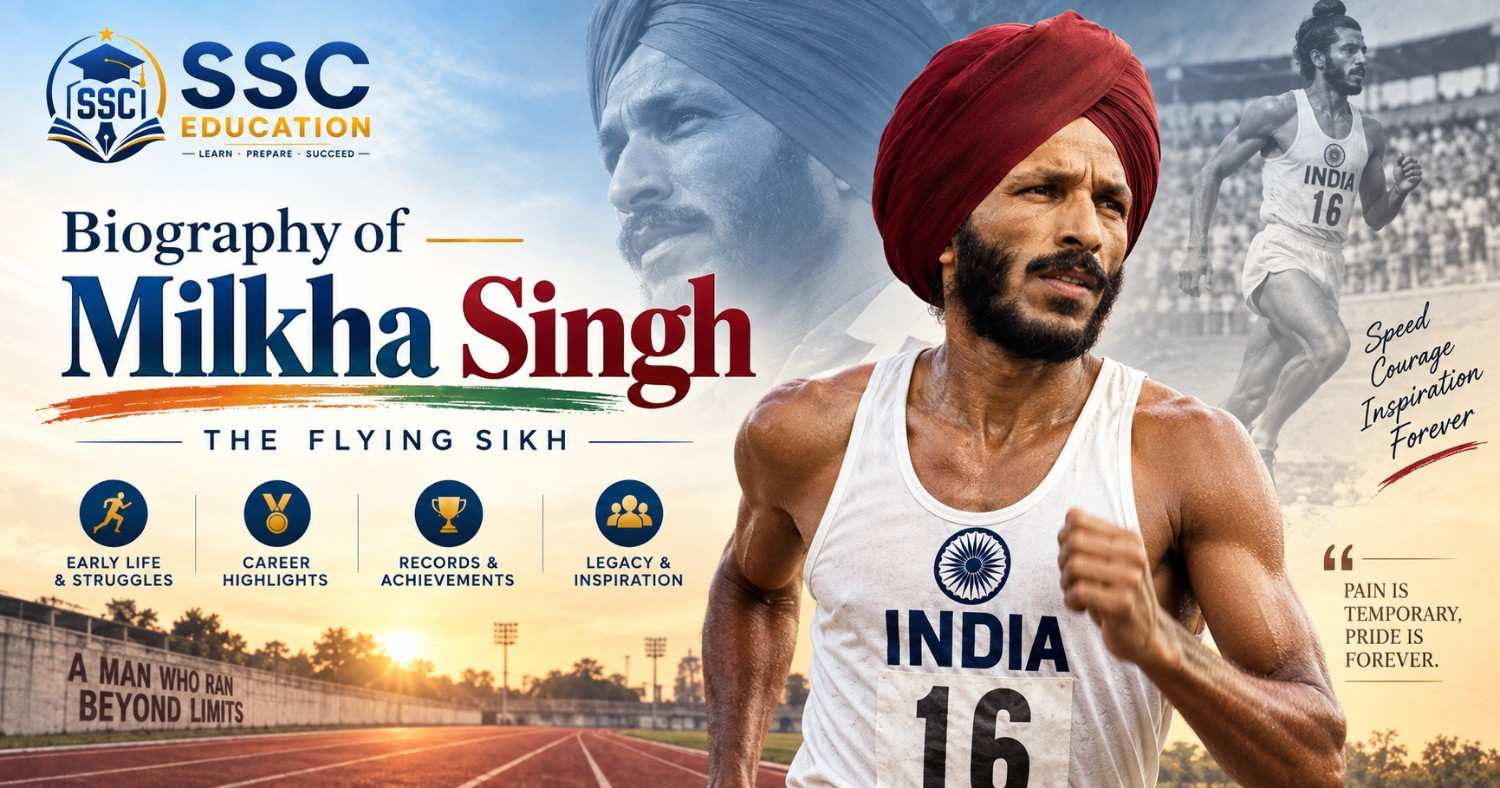
Biography of Milkha Singh
Rahul Kumar
SSC Exam Expert & Content Editor
Table of Contents
- 1.Introduction
- 2.Quick Facts: Milkha Singh
- 3.Early Life and the Trauma of Partition
- 4.Joining the Indian Army
- 5.Rise as a Sprinter
- 6.The 1958 Asian Games and Commonwealth Games
- 7.The Origin of the "Flying Sikh" Title
- 8.The 1960 Rome Olympics: A Historic Near-Miss
- 9.Milkha Singh's Approach to the 1960 Olympic Final
- 10.Later Career and Asian Games Success
- 11.Post-Retirement Life and Contribution to Sports
- 12.Milkha Singh's Decision to Decline the Arjuna Award
- 13.Personal Life
- 14.Milkha Singh's Influence on Later Generations of Indian Athletes
- 15.Autobiography and Film
- 16.Death
- 17.Comparing Milkha Singh's Record to Modern Indian Athletics
- 18.Legacy and Influence
- 19.Milkha Singh in Indian Popular Culture
- 20.Awards and Honours
- 21.Timeline of Milkha Singh's Life
- 22.Milkha Singh's Training Philosophy and Work Ethic
- 23.Milkha Singh's Family Legacy in Sport
- 24.Milkha Singh's Rivalry and Goodwill with Pakistan
- 25.Interesting Facts about Milkha Singh
- 26.Famous Quotes by Milkha Singh
- 27.Why Milkha Singh Still Matters Today
- 28.Frequently Asked Questions (FAQs) about Milkha Singh
- 29.Related Reading
- 30.Conclusion
Milkha Singh (1929-2021), the Flying Sikh, overcame Partition's tragedy to become India's greatest sprinter, reaching the 1960 Olympic 400m final. Read his full biography.
Introduction
Milkha Singh, widely known as the "Flying Sikh," was one of India's greatest track and field athletes and remains an enduring symbol of resilience and national pride. Overcoming the horrors of Partition, in which he lost most of his family, Milkha Singh rose from being a refugee to becoming India's finest sprinter, famously reaching the final of the 400 metres at the 1960 Rome Olympics, the first Indian athlete ever to do so.
In this biography, we cover Milkha Singh's traumatic early life during Partition, his rise through the Indian Army, his legendary sprinting career, his most famous races, his personal life, his death, and his lasting legacy — written in simple, easy-to-understand language, along with commonly searched facts and frequently asked questions.
Quick Facts: Milkha Singh
| Nationality | Indian |
|---|---|
| Best Known For | Olympic sprinter known as "The Flying Sikh" |
| Full Name | Milkha Singh |
| Born | November 20, 1929, Govindpura (now in Pakistan) |
| Died | June 18, 2021 (aged 91), Chandigarh, India |
| Wife | Nirmal Kaur (former captain of the Indian national volleyball team) |
| Son | Jeev Milkha Singh (professional golfer) |
| Known As | The Flying Sikh |
| Famous For | Reaching the 400m final at the 1960 Rome Olympics; four Asian Games gold medals; first Commonwealth Games gold for independent India |
| Famous Book | The Race of My Life (autobiography) |
| Major Awards | Padma Shri (1959), Arjuna Award (posthumous recognition, 2001) |
Early Life and the Trauma of Partition
Milkha Singh was born on November 20, 1929, in the village of Govindpura, in the Punjab province of undivided British India, an area that became part of Pakistan after independence. He was born into a large Sikh family, one of fifteen siblings, though several did not survive childhood. His early life was shattered by the horrific violence of the Partition of India in 1947, during which he witnessed the brutal killing of his parents and several siblings amid the communal riots that swept through Punjab.
Milkha Singh managed to survive by fleeing the violence and eventually made his way to India as a refugee, arriving with nothing and initially living in a refugee camp in Delhi before finding shelter with a married sister. This traumatic loss and displacement during his teenage years profoundly shaped his character, instilling in him an extraordinary determination to survive and succeed against overwhelming odds.
Joining the Indian Army
As a young refugee with an uncertain future, Milkha Singh made several attempts to join the Indian Army, facing repeated rejection before finally being selected in 1951, on his fourth attempt. It was during his time in the Army, particularly through cross-country running competitions and physical training, that his exceptional natural talent for running was discovered by army officials, who encouraged him to pursue athletics seriously. This marked the beginning of his transformation from a traumatised refugee into India's most celebrated track athlete.
Rise as a Sprinter
Milkha Singh trained rigorously, often pushing himself to the point of physical collapse during practice sessions, a level of dedication that became legendary within Indian athletics circles. His hard work paid off quickly, and he rose through the ranks of Indian athletics, specialising in the 200 metres and 400 metres sprint events. He represented India at the 1956 Melbourne Olympics, where, though he did not win a medal, the experience proved invaluable, as he reportedly studied and learned from watching the training methods of other elite international sprinters, further refining his own technique.
The 1958 Asian Games and Commonwealth Games
Milkha Singh's breakthrough on the international stage came in 1958, when he won gold medals in both the 200m and 400m events at the Asian Games in Tokyo. Later that same year, he achieved one of the most historic milestones of his career by winning the 400 metres gold medal at the Commonwealth Games in Cardiff, becoming the first athlete from independent India to win a gold medal at the Commonwealth Games, a landmark achievement that brought him national fame and the nickname that would follow him for the rest of his life.
The Origin of the "Flying Sikh" Title
Milkha Singh's famous nickname, the "Flying Sikh," is widely credited to General Ayub Khan, then President of Pakistan, who reportedly gave him the title after watching him win a race against Pakistan's fastest sprinter, Abdul Khaliq, during a specially arranged athletics meet in Lahore in 1960. Despite initial reluctance to compete in Pakistan given his traumatic history there, Milkha Singh was persuaded by the Indian government to participate as a gesture of goodwill, and his emphatic victory in the race not only earned him this enduring title but also became a symbol of sporting reconciliation between the two nations.
The 1960 Rome Olympics: A Historic Near-Miss
The defining moment of Milkha Singh's career came at the 1960 Rome Olympics, where he became the first Indian athlete to reach an Olympic athletics final, competing in the 400 metres. Running a phenomenal race, Milkha Singh finished in fourth place with a time of 45.6 seconds, missing out on a bronze medal by a mere 0.1 seconds, a result that remains one of the most heartbreaking near-misses in Indian Olympic history. Despite not winning a medal, his performance was widely regarded as a heroic achievement, given that no Indian athlete had ever come close to competing at that level on the world stage, and his time remained the Indian national record in the 400m for decades afterward.
Milkha Singh's Approach to the 1960 Olympic Final
Milkha Singh himself later spoke candidly and at length about the 400m Olympic final in Rome, describing it as both the proudest and most painful moment of his athletic career. He recounted that he had taken an early lead in the race but slowed his pace mid-way through, a tactical decision he made based on his training instincts at the time, which ultimately cost him the split-second advantage needed to secure a medal. He carried the weight of this near-miss for decades afterward, often describing it as a lesson that shaped his understanding of sport and life: that the margin between triumph and heartbreak can be vanishingly small, but that the effort and courage required to compete at that level still deserved to be recognised as a victory in its own right, regardless of the final placing on the scoreboard.
Later Career and Asian Games Success
Milkha Singh continued to compete successfully in the years following the Rome Olympics, winning further gold medals in the 400 metres and the 4x400 metres relay at the 1962 Asian Games in Jakarta, adding to his earlier golds from 1958 and cementing his reputation as the finest sprinter in Asia during this era. He also represented India at the 1964 Tokyo Olympics, though by this stage his competitive peak had passed. He eventually retired from competitive athletics in the mid-1960s, having established records and achievements that would remain unmatched by Indian sprinters for decades.
Post-Retirement Life and Contribution to Sports
After retiring from competitive athletics, Milkha Singh served as the Director of Sports in the Punjab state government, a role in which he worked to promote and develop sporting infrastructure and talent identification within the state. He remained closely associated with Indian athletics throughout his life, mentoring young athletes and frequently speaking about the importance of discipline, hard work, and mental resilience in sport, drawing on his own extraordinary personal journey as an example.
Milkha Singh's Decision to Decline the Arjuna Award
In an incident that later became widely known and discussed in Indian sports circles, Milkha Singh reportedly declined to accept the Arjuna Award when it was offered to him decades after his retirement, on the grounds that the honour was intended for emerging and active athletes rather than a legend of his stature, and he felt it would be more meaningful for the award to go to younger sportspersons still building their careers. This decision was widely seen as reflecting his humility and his deep respect for the sporting fraternity as a whole, rather than any personal grievance, and it added to the almost mythic respect with which he was regarded by later generations of Indian athletes and sports administrators.
Personal Life
Milkha Singh married Nirmal Kaur in 1962, who was herself a former captain of the Indian national volleyball team. The couple had four children, including a son, Jeev Milkha Singh, who went on to become a highly successful professional golfer, representing India on the international golf circuit, including the European Tour, carrying forward the family's sporting legacy into a new generation and a different sport.
Milkha Singh's Influence on Later Generations of Indian Athletes
Long after his own competitive career ended, Milkha Singh remained an active and visible presence in Indian athletics, frequently attending major sporting events, mentoring young athletes, and speaking publicly about the importance of perseverance and national pride in sport. Many later Indian athletes, particularly in track and field, have cited him as a foundational inspiration, both for his athletic achievements and for the way he represented the possibility of overcoming even the most devastating personal circumstances through disciplined effort. His interactions with young sportspersons, often delivered with characteristic warmth and humour despite the gravity of his own life story, helped humanise the sometimes distant image of a national sporting legend, and he remained a beloved, approachable figure in Indian sports culture well into his nineties.
Autobiography and Film
In 2013, Milkha Singh released his autobiography, "The Race of My Life," co-written with his daughter, Sonia Sanwalka, offering a detailed and emotional account of his traumatic early life, his athletic career, and his personal reflections on resilience and success. The book was subsequently adapted into a highly successful and critically acclaimed Bollywood biographical film, "Bhaag Milkha Bhaag" (2013), starring actor Farhan Akhtar, which dramatised his life story for a new generation of Indians and significantly renewed public interest in and admiration for his extraordinary achievements.
Death
Milkha Singh passed away on June 18, 2021, at the age of 91, in Chandigarh, India, after contracting COVID-19 during the pandemic. His death came just days after his wife, Nirmal Kaur, also passed away from COVID-19-related complications, a devastating loss that was widely mourned across India, with tributes pouring in from across the political spectrum, the sporting world, and the general public, reflecting the deep respect and affection he had earned over his lifetime.
Comparing Milkha Singh's Record to Modern Indian Athletics
Milkha Singh's Rome Olympics timing of 45.6 seconds in the 400m remained the Indian national record for an extraordinary 38 years, a testament to how far ahead of his contemporaries he was during his competitive peak, and it was only broken in 1998. This longevity of his record, achieved decades before India had access to modern sports science, specialised training facilities, and international coaching exposure that later generations of athletes would benefit from, is frequently cited by sports historians as evidence of his truly exceptional natural talent and dedication. Even as Indian athletics has modernised significantly in the decades since his retirement, Milkha Singh's achievements are still referenced as a benchmark, and his near-medal performance at the Rome Olympics remained, for many years, the closest an Indian track and field athlete had come to an Olympic medal in an individual running event.
Legacy and Influence
Milkha Singh's legacy extends far beyond his medal count, which, remarkably, does not include an Olympic medal despite his status as one of India's greatest-ever athletes. His story of overcoming the trauma of Partition to become a national sporting hero has inspired generations of Indian athletes and continues to be cited as one of the most powerful examples of resilience in Indian sporting history. He is widely credited with helping to raise the profile and credibility of Indian athletics on the international stage during an era when Indian sport had little global recognition, and his personal journey remains a touchstone for stories of triumph over adversity in Indian popular culture.
Milkha Singh in Indian Popular Culture
Beyond the highly successful 2013 film "Bhaag Milkha Bhaag," Milkha Singh's life story has been referenced extensively across Indian media, sports journalism, and motivational literature over the decades. His journey has been the subject of numerous documentaries, magazine profiles, and school textbook chapters, often used as a case study in resilience for students studying both sports and civics curricula in India. Public institutions, including stadiums and athletic tracks in Punjab and other parts of India, have been named or renamed in his honour, and his life story continues to be cited by motivational speakers, coaches, and public figures across India as an example of overcoming extreme adversity through discipline and self-belief.
Awards and Honours
Milkha Singh was honoured with the Padma Shri, India's fourth-highest civilian award, in 1959, in recognition of his sporting achievements, becoming one of the earliest Indian athletes to receive such national recognition. Numerous sports academies, stadiums, and athletics events across India have been named in his honour, and he continues to be celebrated as one of the defining sporting icons of independent India's early decades, regularly referenced in discussions of the country's greatest-ever athletes.
Timeline of Milkha Singh's Life
| Year | Event |
|---|---|
| 1929 | Born on November 20 in Govindpura, Punjab (now in Pakistan). |
| 1947 | Survived the violence of Partition, losing his parents and several siblings; fled to India as a refugee. |
| 1951 | Joined the Indian Army on his fourth attempt. |
| 1956 | Represented India at the Melbourne Olympics. |
| 1958 | Won gold in the 200m and 400m at the Asian Games; won gold in the 400m at the Commonwealth Games in Cardiff, a first for independent India. |
| 1959 | Awarded the Padma Shri. |
| 1960 | Defeated Abdul Khaliq in Lahore, earning the "Flying Sikh" title; finished fourth in the 400m final at the Rome Olympics. |
| 1962 | Won gold in the 400m and 4x400m relay at the Asian Games in Jakarta; married Nirmal Kaur. |
| 1964 | Represented India at the Tokyo Olympics. |
| 2013 | Released his autobiography, "The Race of My Life"; the film "Bhaag Milkha Bhaag" was released. |
| 2021 | Died on June 18 in Chandigarh from COVID-19 complications. |
Milkha Singh's Training Philosophy and Work Ethic
Milkha Singh's training regimen became legendary within Indian sporting circles for its sheer intensity. He was known to train for hours each day, often to the point of physical exhaustion and, on occasion, reportedly vomiting blood after particularly gruelling sessions, a level of dedication he attributed directly to his determination to escape the poverty and trauma of his refugee past. He frequently spoke in later interviews about how running became not just a sport but a form of personal salvation, a way of channelling the pain of his early losses into a relentless drive for excellence. This intense, almost obsessive work ethic is frequently cited by coaches and sports psychologists in India as a case study in extreme dedication and mental toughness in athletic training.
Milkha Singh's Family Legacy in Sport
The Milkha Singh family's connection to elite sport extended well beyond his own athletic career. His wife, Nirmal Kaur, was herself an accomplished sportsperson, having captained the Indian national volleyball team before their marriage, meaning the couple's household was steeped in competitive sporting culture from the very beginning. Their son, Jeev Milkha Singh, chose golf rather than athletics, but went on to achieve considerable success of his own, becoming the first Indian golfer to win on the European Tour and later winning multiple Asian Tour titles, carrying the family's competitive spirit and sporting excellence into an entirely different discipline and a new generation, a continuation that Milkha Singh himself often spoke about with visible pride in later interviews.
Milkha Singh's Rivalry and Goodwill with Pakistan
Milkha Singh's relationship with Pakistan, the country of his birth and the site of his family's tragic deaths during Partition, was complex and evolved significantly over his lifetime. His initial reluctance to compete in Lahore in 1960, given his personal history, gave way to what became one of the most celebrated moments of sporting diplomacy between the two nations, when his victory over Abdul Khaliq was met with generous applause and respect from the Pakistani crowd and officials, including the nickname bestowed by President Ayub Khan himself. This event is frequently cited as a rare example of sport transcending the deep political and historical tensions between India and Pakistan, and Milkha Singh himself spoke in later years about the mutual respect this race fostered between him and his Pakistani rival.
Interesting Facts about Milkha Singh
- He lost most of his immediate family, including his parents, during the violence of the 1947 Partition.
- He was rejected three times before finally being accepted into the Indian Army on his fourth attempt.
- His 400m Olympic time from 1960 remained the Indian national record for nearly 40 years.
- His nickname, "Flying Sikh," was given to him by the President of Pakistan after a famous race in Lahore.
- His son, Jeev Milkha Singh, became a professional golfer on the international circuit.
- He and his wife, Nirmal Kaur, both passed away within days of each other due to COVID-19 in 2021.
Famous Quotes by Milkha Singh
- "I have seen death very closely, twice in my life, and I know that it is a passing phase."
- "Hard work and dedication are the only shortcuts to success."
- "Records are meant to be broken, but the spirit with which you achieve them lasts forever."
Why Milkha Singh Still Matters Today
Milkha Singh's life remains one of the most inspiring stories in Indian sporting history, illustrating how personal tragedy and adversity can be transformed into extraordinary achievement through sheer determination and discipline. For young athletes and students in India, his journey from an orphaned Partition refugee to a national sporting icon, without ever winning an Olympic medal, continues to demonstrate that legacy and inspiration are not measured by medals alone. His story remains a staple of motivational literature, school curricula, and popular culture in India, ensuring that new generations continue to learn about his remarkable life long after his passing.
Frequently Asked Questions (FAQs) about Milkha Singh
1. Who was Milkha Singh?
Milkha Singh was a legendary Indian sprinter, known as the "Flying Sikh," who became the first Indian athlete to reach an Olympic athletics final, at the 1960 Rome Olympics.
2. When and where was Milkha Singh born?
He was born on November 20, 1929, in the village of Govindpura, in Punjab province, in an area that is now part of Pakistan.
3. Why is Milkha Singh called the "Flying Sikh"?
He earned this nickname from Pakistani President Ayub Khan after defeating Pakistan's top sprinter, Abdul Khaliq, in a race in Lahore in 1960.
4. Did Milkha Singh win an Olympic medal?
No, he famously finished fourth in the 400m final at the 1960 Rome Olympics, missing out on a bronze medal by just 0.1 seconds.
5. What happened to Milkha Singh's family during Partition?
He lost his parents and several siblings during the violence of the 1947 Partition of India and fled to India as a refugee.
6. What awards did Milkha Singh receive?
He was awarded the Padma Shri, India's fourth-highest civilian honour, in 1959.
7. What is "Bhaag Milkha Bhaag"?
It is a 2013 Bollywood biographical film based on Milkha Singh's autobiography, starring actor Farhan Akhtar, which dramatised his life story.
8. How did Milkha Singh die?
He died on June 18, 2021, in Chandigarh, India, due to complications from COVID-19, just days after his wife also passed away from the virus.
9. Who is Milkha Singh's son?
His son, Jeev Milkha Singh, became a professional golfer who represented India on the international golf circuit, including the European Tour.
10. What were Milkha Singh's biggest achievements?
His biggest achievements include reaching the 1960 Olympic 400m final, winning Commonwealth Games gold in 1958, and winning four Asian Games gold medals.
11. Did Milkha Singh write a book?
Yes, he released his autobiography, "The Race of My Life," in 2013, co-written with his daughter, Sonia Sanwalka.
12. Which event was Milkha Singh's specialty?
He specialised in the 400 metres sprint, though he also competed successfully in the 200 metres event.
13. How long did Milkha Singh's national record stand?
His 1960 Olympic timing of 45.6 seconds in the 400m remained the Indian national record for approximately 38 years, until it was broken in 1998.
14. Did Milkha Singh accept the Arjuna Award?
He reportedly declined to accept the Arjuna Award later in life, believing it should go to younger, actively competing athletes rather than a retired legend.
15. What role did Milkha Singh play after retiring from athletics?
He served as the Director of Sports for the Punjab state government, working to develop sporting infrastructure and mentor young athletes.
Related Reading
Conclusion
Milkha Singh's life stands as one of the most remarkable stories of resilience in Indian sporting history. From surviving the horrors of Partition as a teenage refugee to becoming the first Indian athlete to reach an Olympic final, his journey embodies the triumph of determination over tragedy. Though an Olympic medal eluded him by the narrowest of margins, the "Flying Sikh" remains one of India's most beloved and inspirational sporting icons, a symbol of what discipline, courage, and an unbreakable spirit can achieve against the most difficult of circumstances.
Rahul Kumar
SSC Exam Expert & Content Editor
Rahul is a senior SSC exam strategist with 8+ years of experience helping aspirants crack CGL, CHSL and MTS exams. He writes in-depth notification breakdowns, exam pattern guides and preparation strategies.