
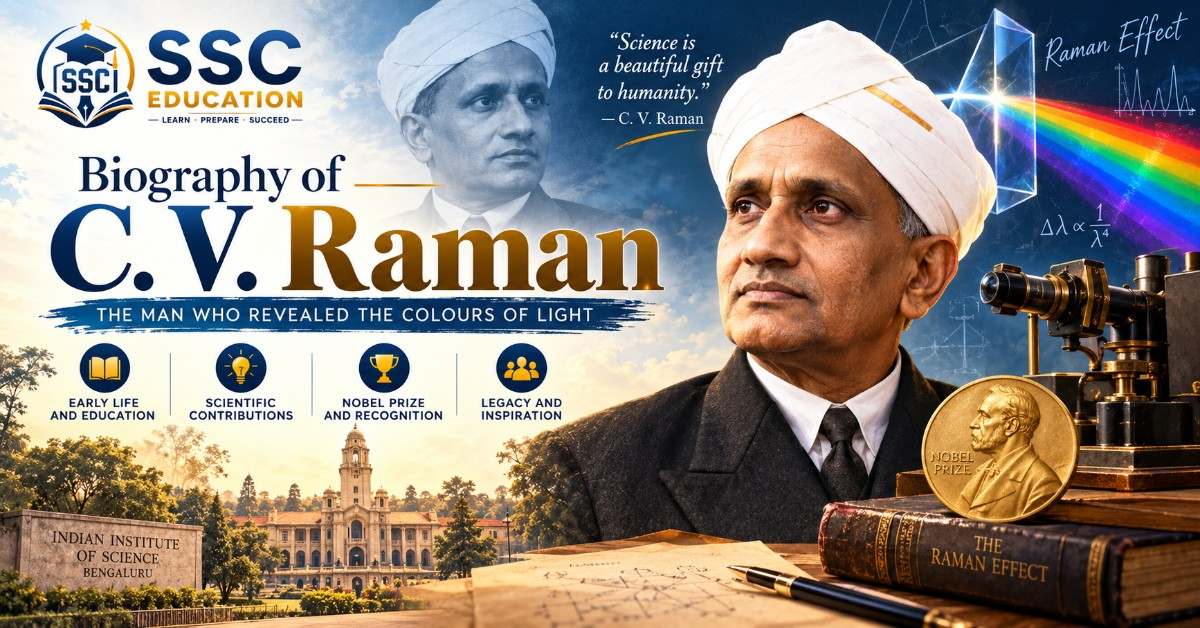
Biography of C. V. Raman
Rahul Kumar
SSC Exam Expert & Content Editor
Table of Contents
- 1.C. V. Raman Biography at a Glance (Quick Facts)
- 2.Who Was C. V. Raman?
- 3.C. V. Raman Early Life and Family
- 4.C. V. Raman Education
- 5.Government Job and Science After Office Hours
- 6.Joining Calcutta University (1917)
- 7.Why Is the Sea Blue? The Voyage of 1921
- 8.The Raman Effect: Explained in Simple Words
- 9.C. V. Raman Nobel Prize (1930)
- 10.Raman as the Director of the Indian Institute of Science
- 11.The Raman Research Institute (1948)
- 12.Other Work of C. V. Raman
- 13.C. V. Raman Timeline (Year-Wise History)
- 14.C. V. Raman Awards and Honours
- 15.National Science Day: 28 February
- 16.Personality and Beliefs of C. V. Raman
- 17.How Did C. V. Raman Die? (Death Reason)
- 18.C. V. Raman Legacy: Why He Is Remembered
- 19.Interesting Facts About C. V. Raman
- 20.C. V. Raman Biography: Important Points for SSC and Other Exams
- 21.Lessons Students Can Learn from C. V. Raman
- 22.Raman Effect and Rayleigh Scattering: What Is the Difference?
- 23.Simple Science Activities Inspired by C. V. Raman
- 24.Struggles and Criticism in Raman's Life
- 25.Related People and Topics
- 26.Key Takeaways
- 27.C. V. Raman Biography: Frequently Asked Questions (FAQs)
Read the C. V. Raman biography in simple words: early life, education, Raman Effect, why the sea is blue, Nobel Prize 1930, National Science Day, institutes he founded, death and contribution to science.
Sir Chandrasekhara Venkata Raman, known as C. V. Raman (7 November 1888 – 21 November 1970), was a great Indian physicist. This C. V. Raman biography tells his life story, history and contribution to science in very simple words. He is famous for the Raman Effect, discovered on 28 February 1928, which explains how light changes when it passes through a material. For this work, he won the Nobel Prize in Physics in 1930, and became the first Asian to win a Nobel Prize in science. India celebrates 28 February every year as National Science Day in his honour.
C. V. Raman Biography at a Glance (Quick Facts)
| Detail | Information |
|---|---|
| Full Name | Chandrasekhara Venkata Raman |
| Born | 7 November 1888 |
| Birthplace | Tiruchirappalli (Trichinopoly), Madras Presidency, Tamil Nadu |
| Died | 21 November 1970 (aged 82) |
| Place of Death | Bangalore (Bengaluru), Karnataka |
| Famous For | The Raman Effect; Nobel Prize in Physics, 1930 |
| Father | Chandrasekhara Ramanathan Iyer (a lecturer in physics and maths) |
| Mother | Parvathi Ammal |
| Wife | Lokasundari Ammal |
| Education | Presidency College, Madras (B.A. 1904, M.A. 1907) |
| Major Awards | Nobel Prize (1930), Knighthood (1929), Bharat Ratna (1954), Lenin Peace Prize (1957) |
| Institutions Founded | Indian Academy of Sciences (1934), Raman Research Institute (1948) |
| National Science Day | 28 February, the day of the discovery of the Raman Effect |
| Nephew | Subrahmanyan Chandrasekhar (Nobel Prize in Physics, 1983) |
Who Was C. V. Raman?
C. V. Raman was one of the best scientists India has ever produced. He was curious about how nature works, especially about light and sound. He worked in his own country, with simple tools, and made a discovery that impressed the whole world.
He was a good teacher and a strong leader of Indian science. He started an academy of sciences and a research institute. He inspired thousands of students to take up science. He also believed that India could do first-class science at home, without depending on other countries. This belief made him a hero for Indian scientists.
If a student asks, "Who is C. V. Raman?", the short answer is: the Indian scientist who discovered the Raman Effect and won the Nobel Prize in 1930.
C. V. Raman Early Life and Family
Birth and Family Background
Raman was born on 7 November 1888 in Tiruchirappalli, a town in Tamil Nadu (then a part of the Madras Presidency). He was the second of eight children. His father, Chandrasekhara Ramanathan Iyer, was a teacher of mathematics and physics in a college. His mother, Parvathi Ammal, came from a family of Sanskrit scholars.
The family was not rich, but they loved learning. There were books in the house, and the father had a small collection of science books and even a few instruments. This made young Raman curious about science from his early days.
Childhood in Visakhapatnam
When Raman was about four years old, his father took a job in a college in Visakhapatnam (Vizag), on the east coast of Andhra Pradesh. The family shifted there. Raman grew up near the sea, and this may have planted the first seeds of his later thoughts about the blue colour of the sea.
He studied at St. Aloysius' Anglo-Indian High School in Vizag. He was a brilliant child. He passed his matriculation at the age of 11 and the intermediate exam at the age of 13, which is much earlier than most students.
C. V. Raman Education
After his school studies, Raman joined the famous Presidency College in Madras (now Chennai). He was only 15 years old at the time. He was so bright that in 1904, at the age of 16, he passed his B.A. degree, standing first in the university, with gold medals in physics and English.
He then did his M.A. in physics in 1907 with the highest honours. Even while he was a student, he wrote research papers. In 1906, when he was just 18, his first paper on the diffraction of light was published in the well-known British journal Philosophical Magazine. This was a rare achievement for a student, especially from India at that time.
Government Job and Science After Office Hours
After the M.A., Raman wanted to become a full-time scientist. But at that time, there were almost no research jobs in India. Following the advice of his teachers, he took the Indian Finance Service exam in 1907. He came first, and he joined as an Assistant Accountant General in Calcutta when he was just 19.
In 1907, he also got married to Lokasundari Ammal. The couple later had two sons. One of them, V. Radhakrishnan, became a well-known astronomer.
In Calcutta, Raman found a small lab called the Indian Association for the Cultivation of Science (IACS), which had been started by Dr. Mahendralal Sircar. He used to go there after his office hours and on holidays. He did experiments on light and sound with the simplest equipment. He worked on the sounds of musical instruments like the violin, veena, tabla and mridangam, and showed how the harmonics of the Indian drums are special. His work got noticed by scientists in India and abroad.
Joining Calcutta University (1917)
By 1917, Raman was a well-known name in science. Sir Ashutosh Mukherjee, the Vice-Chancellor of Calcutta University, invited him to become the Palit Professor of Physics at the university. It was a big decision because the job paid less than his government post. But Raman left his government service, and became a full-time scientist.
At Calcutta University, he built a research group. Many talented students came to work with him, including K. S. Krishnan, who later worked with him on the Raman Effect. In 1924, Raman was elected a Fellow of the Royal Society (FRS) in London, a big honour for a scientist.
Why Is the Sea Blue? The Voyage of 1921
In 1921, Raman travelled by ship, the SS Narkunda, to England to attend a conference at Oxford. During the long sea journey, he looked at the deep blue colour of the Mediterranean Sea. At that time, the popular explanation, given by the famous scientist Lord Rayleigh, was that the sea is blue because it reflects the blue colour of the sky.
Raman was not convinced. He took out a simple tool, a small Nicol prism (which he kept with him), and looked at the sea through it. He found that the blue colour did not come only from the reflection of the sky. He decided to study it. When he returned to India, he did more experiments and found that the blue colour of the sea comes mainly from the scattering of light by water molecules themselves. He published his idea in the journal Nature.
This work led him to a bigger study of how light scatters in liquids, and this led to his big discovery in 1928.
The Raman Effect: Explained in Simple Words
What Is the Raman Effect?
Light is made of tiny packets of energy called photons. When a beam of light passes through a transparent material, such as a liquid, a gas or a crystal, most of the light goes straight through or gets scattered in different directions without changing its colour. But Raman found that a very tiny part of the scattered light changes its colour. The change in colour is called the Raman Effect or Raman scattering.
Think of a ball hitting a moving wall. If the wall is still, the ball bounces back at the same speed. But if the wall is vibrating, the ball may bounce back faster or slower, depending on how the wall moves. In the same way, when a photon hits a molecule, the molecule may be vibrating or spinning. The photon may give some energy to the molecule, or take some from it. Because of this exchange, the scattered photon has a bit less or a bit more energy than before, and so its colour changes a little.
The Discovery on 28 February 1928
Raman and his student K. S. Krishnan used sunlight, a set of filters, and a simple telescope to look at scattered light from different liquids. They noticed a faint light with a different colour from the original light. Raman then used a stronger light source and a better spectrograph to see the effect clearly. On 28 February 1928, he was sure that a new type of scattering had been discovered.
He quickly sent the news to the journal Nature, and the paper, "A new type of secondary radiation", was published in March 1928. Scientists around the world repeated the experiment and confirmed it. It was a great moment for Indian science, because the discovery was made in India, using equipment made and bought at a very low cost.
Why the Raman Effect Is Important
The change in the colour of scattered light is like a fingerprint. Each material has its own pattern of changes. By reading this pattern, scientists can find out what a material is made of and how its molecules are arranged. Today this technique is known as Raman spectroscopy.
| Field | How Raman Spectroscopy Is Used |
|---|---|
| Chemistry | To identify chemicals and study how molecules are built |
| Medicine | To study tissues and help in the detection of diseases such as cancer |
| Pharmacy | To check the quality of medicines and find fake drugs |
| Police and forensic science | To identify drugs, explosives and other materials at crime scenes |
| Art and history | To study old paintings, pigments and ancient objects without damaging them |
| Space science | To study rocks and minerals on other planets |
C. V. Raman Nobel Prize (1930)
In 1930, Raman was awarded the Nobel Prize in Physics "for his work on the scattering of light and for the discovery of the effect named after him". He was the first Asian, and the first person who was not white, to win a Nobel Prize in science. He was also the first Indian to win a Nobel in science. Rabindranath Tagore had won the Nobel Prize in Literature in 1913.
It is said that Raman was so sure that he would win the prize that he had already booked his tickets to Stockholm months before the announcement. The story is widely told, and it shows his confidence. He received the prize at a ceremony in Stockholm in December 1930.
In 1929, he was already knighted by the British government, and he was called "Sir C. V. Raman". He always took great pride in the fact that the discovery was made by an Indian, in India.
Raman as the Director of the Indian Institute of Science
In 1933, Raman moved to Bangalore to become the first Indian director of the Indian Institute of Science (IISc). He was a strict and passionate director. He wanted to build a strong physics department, and he brought young scientists. He was also open to new ideas. During his time, he invited some famous scientists to visit IISc.
But his management style was strong, and some people did not like it. He left the director's post in 1937 but continued as a professor at IISc till 1948.
In 1934, he founded the Indian Academy of Sciences, which still publishes journals and encourages science in India.
The Raman Research Institute (1948)
After leaving IISc, Raman started his own research institute in Bangalore in 1948. It is called the Raman Research Institute (RRI). He paid for it with his own money and donations. He worked there for the rest of his life on many subjects, such as the colour of flowers, the structure of diamonds, the physics of gems, the working of the human eye, and the sounds of musical instruments. His son, V. Radhakrishnan, later became the director of the institute.
Even now, the RRI is a respected centre for research in astronomy, light and matter.
Other Work of C. V. Raman
- Music and acoustics: He studied the sound of the violin, the veena, the tabla and the mridangam. He showed that the Indian drums produce harmonic overtones.
- Raman-Nath theory (1935): With N. S. Nagendra Nath, he explained how light bends when it passes through a liquid with sound waves.
- Crystals and minerals: He studied the structure of diamonds, and the beautiful colours of opals, pearls, and other gems.
- Colour and vision: He worked on how the human eye sees colour.
- Flowers and colours: In later years, he did research on why flowers have their colours.
C. V. Raman Timeline (Year-Wise History)
| Year | Event |
|---|---|
| 1888 | Born on 7 November in Tiruchirappalli |
| 1904 | Gets B.A. degree from Presidency College, Madras, standing first |
| 1906 | His first research paper is published |
| 1907 | Gets M.A.; joins the Indian Finance Service in Calcutta; marries Lokasundari Ammal |
| 1917 | Becomes the Palit Professor of Physics at Calcutta University |
| 1921 | Sea voyage to England; becomes interested in the blue of the sea |
| 1924 | Elected Fellow of the Royal Society |
| 28 February 1928 | Discovers the Raman Effect |
| 1929 | Knighted by the British government |
| 1930 | Wins the Nobel Prize in Physics |
| 1933 | Becomes the director of IISc, Bangalore |
| 1934 | Founds the Indian Academy of Sciences |
| 1948 | Founds the Raman Research Institute |
| 1954 | Receives the Bharat Ratna |
| 1957 | Receives the Lenin Peace Prize |
| 1970 | Dies on 21 November in Bangalore |
C. V. Raman Awards and Honours
| Honour | Year |
|---|---|
| Matteucci Medal (Italy) | 1928 |
| Knight Bachelor (Sir) | 1929 |
| Hughes Medal, Royal Society | 1930 |
| Nobel Prize in Physics | 1930 |
| Bharat Ratna | 1954 |
| Lenin Peace Prize (Soviet Union) | 1957 |
| National Science Day on 28 February | Celebrated since 1987 in his honour |
National Science Day: 28 February
In 1986, the National Council for Science and Technology Communication asked the Government of India to observe a day for science. The government decided that 28 February, the day of the discovery of the Raman Effect, would be celebrated as National Science Day. It was first celebrated in 1987. Every year, schools, colleges and science centres hold exhibitions, talks and competitions on this day. Each year has a theme that is chosen by the government.
Personality and Beliefs of C. V. Raman
Raman was proud, hard-working and honest. He believed that science should be done with love and curiosity, and not just for a job. He also believed in doing good science with what one had, and not blaming a lack of money. His lab was known for simple equipment and brilliant ideas.
He was known for strong opinions. He did not hesitate to criticise ideas or people if he felt that they were wrong. Sometimes, this made others unhappy. But he was also warm to students who worked hard. He loved nature, music and flowers, and he kept a garden and a collection of gems and minerals.
How Did C. V. Raman Die? (Death Reason)
In October 1970, Raman had a heart attack while working in his lab. He was taken to a hospital, but he did not want to stay there. He insisted on going back to his institute, and to be near his garden. On 21 November 1970, he died in Bangalore at the age of 82. He worked almost until the last days of his life.
C. V. Raman Legacy: Why He Is Remembered
C. V. Raman is remembered as a great scientist and a great Indian. The Raman Effect is used in labs, hospitals and space missions all over the world. Raman spectroscopy is a routine method used by chemists and doctors. His name lives on in the Raman Research Institute, in the Raman Fellowships, in the scientific term "Raman scattering" and on National Science Day.
His nephew, Subrahmanyan Chandrasekhar, went on to win the Nobel Prize in Physics in 1983 for his work on the stars. Together, they are one of the greatest scientific families in history.
Interesting Facts About C. V. Raman
- He passed matriculation at 11 and B.A. at 16.
- His first research paper was published when he was 18.
- He worked as an accountant and did science in his free time.
- He discovered the Raman Effect with simple equipment costing very little.
- He was the first Asian to win a Nobel Prize in science.
- He used a pocket Nicol prism to look at the sea on his voyage in 1921.
- He studied the sounds of Indian musical instruments.
- His nephew S. Chandrasekhar also won the Nobel Prize.
- He founded his own research institute in 1948.
- The Raman Effect is now used in Raman spectroscopy in medicine, chemistry and space science.
C. V. Raman Biography: Important Points for SSC and Other Exams
- Born on 7 November 1888 in Tiruchirappalli; died on 21 November 1970 in Bangalore.
- Discovered the Raman Effect on 28 February 1928.
- National Science Day is celebrated on 28 February.
- Nobel Prize in Physics in 1930, the first Asian to win a Nobel in science.
- Bharat Ratna in 1954.
- Founded the Indian Academy of Sciences (1934) and the Raman Research Institute (1948).
- Was the first Indian director of IISc, Bangalore (1933–37).
- Worked with K. S. Krishnan on the Raman Effect.
- His nephew S. Chandrasekhar won the Nobel Prize in 1983.
Practice Questions (with Answers)
| Question | Answer |
|---|---|
| Which effect is named after C. V. Raman? | The Raman Effect |
| On which date is National Science Day celebrated? | 28 February |
| In which year did Raman win the Nobel Prize? | 1930 |
| Who was the student who worked with Raman on the Raman Effect? | K. S. Krishnan |
| What institute did Raman start in 1948? | The Raman Research Institute (Bangalore) |
Lessons Students Can Learn from C. V. Raman
- Be curious. A simple question about the colour of the sea led him to the Nobel Prize.
- Do more with less. He proved that great science can be done with simple equipment.
- Do not depend on a big lab. He worked after office hours in a small lab.
- Work hard and read a lot. His early success came from hard work and love of learning.
- Believe in your country. He showed that Indians can lead the world in science.
Raman Effect and Rayleigh Scattering: What Is the Difference?
Students often mix up the Raman Effect with another type of scattering called Rayleigh scattering. The table below makes the difference clear.
| Point | Rayleigh Scattering | Raman Scattering |
|---|---|---|
| Named after | Lord Rayleigh (British scientist) | C. V. Raman |
| Colour of scattered light | Same as the original light | Slightly different from the original light |
| Energy of the photon | Does not change | Changes a little (goes up or down) |
| How common is it? | Very common; most of the scattered light | Very rare; only a tiny fraction of the scattered light |
| What it tells us | Why the sky looks blue | What a material is made of and how its molecules vibrate |
Simple Science Activities Inspired by C. V. Raman
You do not need a big lab to enjoy the science of light. Here are three safe activities that students can try at home or in school with the help of a teacher.
- Blue sky at home: Fill a glass with water and add a few drops of milk. Shine a torch through the glass in a dark room. The water looks bluish from the side and reddish-yellow from the end. This shows how light scatters in small particles, like it does in the sky.
- Rainbow with a CD: Look at a CD or a DVD in sunlight. The colours you see are due to the diffraction of light. Raman started his career with a study of diffraction.
- Sound of vibrating strings: Pluck a rubber band stretched over a box. Change its length and tightness and listen to the changes in pitch. This is the type of simple experiment Raman did when he studied musical instruments.
Struggles and Criticism in Raman's Life
Raman's life was not free from problems. In the early days, he had to work in a government job because there was no place for a scientist in India. He faced difficulties with funding, and sometimes with his colleagues and with the government. His strong opinions often led to disagreements. But he never gave up his commitment to science.
His story tells students an important thing: success in science does not depend only on a fancy lab. It depends on curiosity, discipline and the courage to ask questions.
Related People and Topics
You can also read about K. S. Krishnan, Subrahmanyan Chandrasekhar, Jagadish Chandra Bose, Homi J. Bhabha, Vikram Sarabhai, Satyendra Nath Bose, Meghnad Saha, the Nobel Prize in Physics, National Science Day and Raman spectroscopy.
Key Takeaways
- C. V. Raman (1888–1970) was a great Indian physicist.
- He discovered the Raman Effect on 28 February 1928 and won the Nobel Prize in 1930.
- National Science Day is celebrated in India on 28 February in honour of this discovery.
- He founded the Indian Academy of Sciences and the Raman Research Institute.
- He showed that the blue colour of the sea is caused mostly by scattering of light in water.
- He died on 21 November 1970 in Bangalore.
C. V. Raman Biography: Frequently Asked Questions (FAQs)
Q1. Who was C. V. Raman?
C. V. Raman was a great Indian physicist who discovered the Raman Effect. He won the Nobel Prize in Physics in 1930 and was the first Asian to win a Nobel in science.
Q2. When and where was C. V. Raman born?
He was born on 7 November 1888 in Tiruchirappalli (Trichinopoly), in the Madras Presidency, now in Tamil Nadu.
Q3. Who were the parents of C. V. Raman?
His father was Chandrasekhara Ramanathan Iyer, a lecturer in physics and mathematics. His mother was Parvathi Ammal.
Q4. Where did C. V. Raman study?
He studied at St. Aloysius' High School in Visakhapatnam and then at Presidency College, Madras, where he got his B.A. in 1904 and M.A. in 1907.
Q5. Why is C. V. Raman famous?
He is famous for the discovery of the Raman Effect and for winning the Nobel Prize in Physics in 1930.
Q6. What is the Raman Effect?
It is the change in the colour (energy) of a small part of light when it is scattered by a material. It is used to find out what a material is made of.
Q7. When was the Raman Effect discovered?
It was discovered on 28 February 1928 by C. V. Raman and his student K. S. Krishnan at Calcutta.
Q8. What is Raman spectroscopy used for?
It is used in chemistry, medicine, forensic science, art and space research to identify materials and study molecules without damaging them.
Q9. Why is the sea blue according to C. V. Raman?
Raman found that the blue colour of the sea is mainly due to the scattering of light by water molecules, and not only by the reflection of the blue sky.
Q10. When did C. V. Raman get the Nobel Prize?
He got the Nobel Prize in Physics in 1930, for his work on the scattering of light and the discovery of the Raman Effect.
Q11. Was C. V. Raman the first Indian Nobel winner?
Rabindranath Tagore won the Nobel Prize in Literature in 1913. Raman was the first Indian, and the first Asian, to win a Nobel Prize in science.
Q12. Why is National Science Day celebrated on 28 February?
It is celebrated on 28 February to mark the discovery of the Raman Effect on this date in 1928. It was first celebrated in 1987.
Q13. Who worked with C. V. Raman on the Raman Effect?
His student K. S. Krishnan worked closely with him on the discovery.
Q14. What did C. V. Raman do before becoming a professor?
He worked in the Indian Finance Service as an Assistant Accountant General in Calcutta and did his research after office hours at the IACS.
Q15. What is the Indian Association for the Cultivation of Science?
It is a research institute in Calcutta started by Dr. Mahendralal Sircar in 1876. Raman did many of his early experiments there.
Q16. Which institutes did C. V. Raman start?
He started the Indian Academy of Sciences in 1934 and the Raman Research Institute in Bangalore in 1948.
Q17. Was C. V. Raman the director of IISc?
Yes. He was the first Indian director of the Indian Institute of Science, Bangalore, from 1933 to 1937.
Q18. Did C. V. Raman get the Bharat Ratna?
Yes. He received the Bharat Ratna in 1954, the year it was first given.
Q19. Who was the nephew of C. V. Raman?
His nephew was Subrahmanyan Chandrasekhar, who won the Nobel Prize in Physics in 1983.
Q20. What other work did C. V. Raman do?
He studied the sound of musical instruments like the tabla and mridangam, the structure of diamonds, the colours of gems and flowers, and the working of the human eye.
Q21. When and how did C. V. Raman die?
He died on 21 November 1970 in Bangalore at the age of 82. He had a heart attack in his lab a few weeks earlier.
Q22. What can students learn from C. V. Raman?
Students can learn to be curious, to work hard with simple resources, and to believe that Indians can do world-class science.
Rahul Kumar
SSC Exam Expert & Content Editor
Rahul is a senior SSC exam strategist with 8+ years of experience helping aspirants crack CGL, CHSL and MTS exams. He writes in-depth notification breakdowns, exam pattern guides and preparation strategies.